
The god Hermes (also called Hermeas, Hermea, Hermeia, Hermia or Hermaon) is the angel, that is, the messenger of Zeus, who connects people with God. Besides, its name contains the roots of the word εἐρmos (= connection/synapse) and the endings -eas and -ia, which indicate that it is constantly in motion.
He was born in a cave on the green Mount Kyllini, in Corinthia, to the beautiful nymph Maia and his father Zeus. The main quality that characterized Hermes as soon as he was born was intelligence, ingenuity and skill. While he was still a baby in swaddling clothes, he got out of his cradle, put on his shoes upside down, so that his fingernails did not show where he was going and left for the mountains of Pieria, where the cows of the god Apollo were grazing. Apollo was not there and the animals were watched over by numerous dogs. But Hermes caused all the dogs to fall into deep lethargy and immediately stole fifty cows. In order not to understand what happened, he tied branches to the animals' ears, so that all their traces and footprints would be erased. Then he headed south, crossed the Isthmus of Corinth and shortly before dawn, arrived at Pylos, near the river Alpheus. There he slaughtered two of the cows, cut their meat into twelve parts and burned them as a sacrifice to the Olympian gods. However, he kept the animals inside. After completing the sacrifice, he hid the rest of the cows in a cave, threw his shoes at Alpheus and returned to Kyllini in the early hours of the morning.
At the entrance of the cave where he lived, he saw a turtle and as ingenuity never left him, he took the turtle, stretched in its empty shell seven strings from the intestines of Apollo's cows and thus created the world's first lyre.
When dawn came, Apollo realized what had happened and quickly went to Hermes' cave. Hermes, however, did not admit his act and Apollo was forced to lead him to Olympus, so that their father could judge the situation. The more Hermes pretended to be ignorant, the more Apollo became irritated. Until Zeus laughed at his son's antics. Zeus laughs, Apollo is indignant, and Hermes confesses the truth. Finally the two brothers are reconciled, Apollo gives Hermes his flocks and Hermes gives Apollo his lyre. Since then, Hermes has been the god who protects the herds of grazing animals. In order to replace his lyre, Hermes made the syringe, the one with which his son, the god Pan, would later play music.
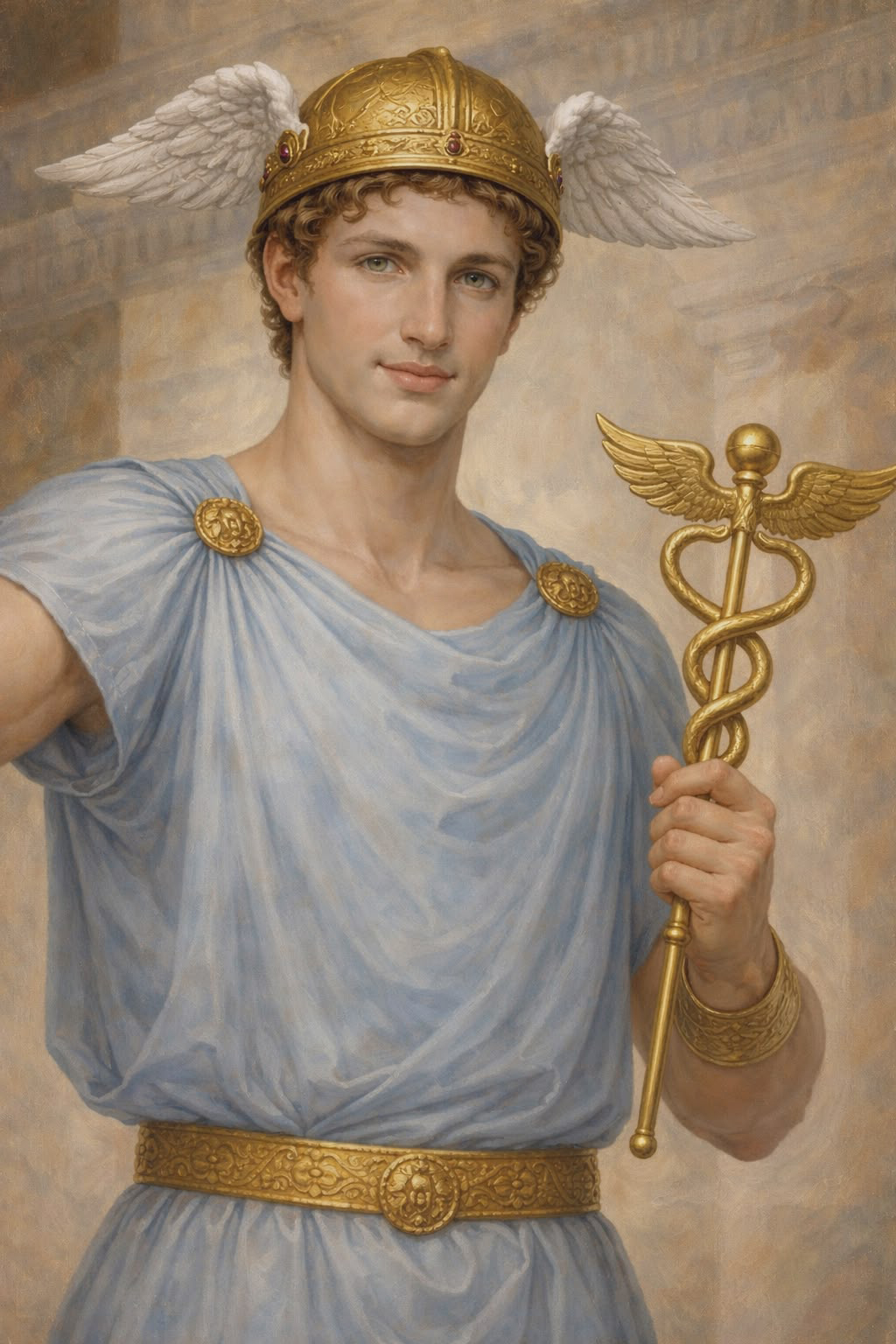
Apollo also gave him the golden rod that Hephaestus had made and with which he leads the flocks. Once Hermes met two large snakes fighting each other and used his golden rod to separate them. Then the two serpents wrapped themselves around his spear and stood there with their heads facing each other. This is how Hermes’ scepter, the caduceus, which is a symbol of peace, was formed, since he reconciled the two serpents. Eimi uses the caduceum in various ways: He touches people on death row with it, who exhale immediately without suffering. He also touches people with it to give them sweet sleep or to wake them up. That is why the ancient Greeks, when they left the banquets to go to sleep, made a libation with wine in honor of the god Hermes and left on his statue the wreaths they wore on their heads. In fact, they were in the habit of carving the figure of the god Hermes at the foot of their beds and having his likeness in their bedrooms.
Because of his deceitful thinking, intelligence, but also many other gifts, such as robustness, agility, speed, diplomacy, persuasion, eloquence and sweetness of words, Zeus chose him as a preacher. So Zeus sent Hermes to Deucalion after the flood, to tell him to ask for whatever grace he wanted. And from Hermes Zeus learned that the grace that Deucalion wanted was for the human race to be recreated. When the goddess Demeter was angry about the abduction of Persephone by Hades and nature was in danger of extinction, it was Hermes who managed to persuade Hades to return Persephone to her mother. And when Zeus created the first woman, Pandora, he ordered Hermes to endow her with a human voice. And Hermes was the one who named her Pandora and led her to Epimetheus to marry her. When once, in order to punish Ios, who slept with Zeus, the goddess Hera transformed her into a cow and put as her guardian the Very Sighted Argos, who As his whole body was full of eyes, Hermes killed him, after first putting him to sleep with music and then beheading him.
 In addition to these, Hermes fought in the Gigantomachy and killed the giant Hippolytus. He managed, when everything seemed lost, to steal the news of Zeus from Typhon and to bring the father of gods and men to his senses, so that the gods could bring order and harmony to the world.
Hermes always stands by the side of the people. He helped Priam to reach the tent of Achilles and ask for the body of the dead Hector by putting the guards of the Achaeans to sleep with his caduceus. Hermes warned Aegisthus not to kill Agamemnon. Hermes also conveyed to Calypsus the order of Zeus to release Odysseus to return to Ithaca.
In order for Hermes to carry out the orders of Zeus, he must be on the road very often and run through roads and roads very quickly. That is why he takes care of the cleanliness of the streets by removing every obstacle and every stone. That is why he is considered the protector, guide and companion of travelers and travelers. Since Hermes protects the roads, every thing that one finds by chance on the road comes from Hermes. The lost objects that are left untouched to their fate were called permea, and Hermes reveals to people what they have lost.
Hermes invented measures, weights, scales and everything else related to trade and is the patron saint of merchants. It is no coincidence that the great commercial street of Athens is Hermes Street. Because merchants often deceive buyers for the sake of profit, and because Hermes has just been born, he has stolen, this god is considered the protector of thieves.
Because of his speed, his agility, his strong and powerful body, but also his ingenuity, which gives birth to tricks that are absolutely necessary in the athletes, Hermes enjoyed honors and had an altar with Hercules and Apollo in the gymnasiums, that is, in the gymnasiums, and in the wrestlers. In fact, Hermes invented the sport of wrestling and protects the athletes.
Hermes also invented letters and geometry. He is a very capable speaker and diplomat and knows perfectly well how to speak beautifully, how to persuade others and how to interpret things. In fact, the word interpretation comes from his name. That is why he is called a Scholar and protects heroes, philosophers and people who love education.
Hermes also has a tender and very important quality: He protects children. As a nurturer, Hermes protected little Dionysus, who was left without a mother, and gave him to the nymphs to raise him. In this way, he also helped Arcadas, the son of Zeus and the bride Callistos, who gave his name to Arcadia. When Callisto was transformed into a bear, so that Arcas, who was a baby at the time, would not be left alone, Hermes took him and gave him to his own mother, Maya, to take care of him. But Hercules was also taken care of by Hermes. Heracles, when he was a baby, had to breastfeed on the milk of the goddess Hera in order to be honored as a god. But Hera did not want him at all. Then Hermes intervened, who managed to secretly touch Hercules on Hera's chest without her realizing it. Hermes also took care of Jonah, the progenitor of the Ionians, whom his mother, Creusa, abandoned on the rock of the Acropolis of Athens as soon as she gave birth to him. Then Hermes took the newborn and carried him to the oracle of Delphi, near his father, Apollo.
Very important is the status of Hermes as the god of fertility. That is why he is often depicted as a simple phallus. Therefore, he is, among other things, both a typhophal and a chthonic god. As a chthonic god with the name Cadmilos, he was worshipped in the mysteries of Samothrace, but also in the mysteries of Eleusis near Demeter, Persephone and Hades. Hermes is the god who leads and accompanies the souls of mortals to the kingdom of the Underworld.
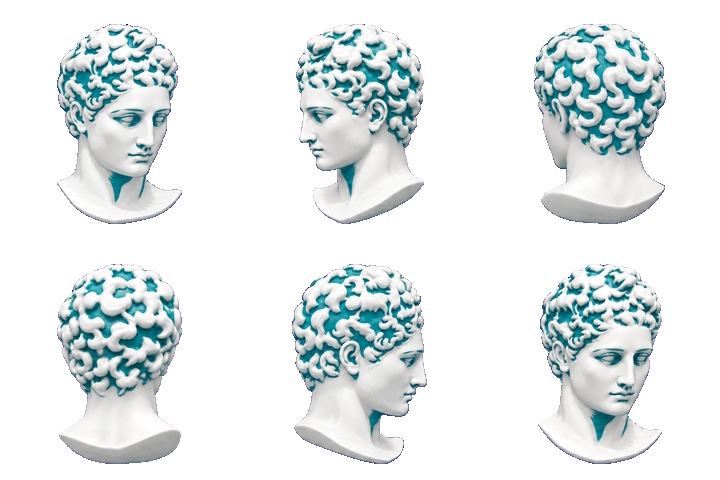
The god Hermes is a very beloved god with a very widespread cult and many representations in art. He is depicted as a young, handsome and robust man either with a long beard and long hair that falls down his shoulders in well-groomed tentacles, or without a beard and short hair.
His symbols are the caduceus, his golden scepter with wrapped snakes, which is sometimes depicted with wings and sometimes without. Wings are always used to depict Hermes' shoes. His hat, the petasos, also has wings. A petasus is a wide-brimmed hat made of leather or straw, with laces to be tied under the jaw. As a symbol of the god Hermes, the petasus was both a symbol of the palaestra and an emblem of the wayfarers. Sometimes the god Hermes is depicted holding a valantium, i.e. a purse, or athletic objects, such as the stlegis, a kind of scraper for cleaning athletes, and the aryvalus, a type of vessel containing oil.
Because of all these attributes of the god Hermes, Hermeion chose to take his name. The journey to knowledge needs speech, language, interpretation, ingenuity... that is, the help and companionship of the god Hermes.