
In view of the celebration of the 28thof the October, the anniversary of the OXI, let us recall how many times in Greek history this denial has been expressed. The refusal of submission, the refusal of subjugation, the denial of the loss of freedom.
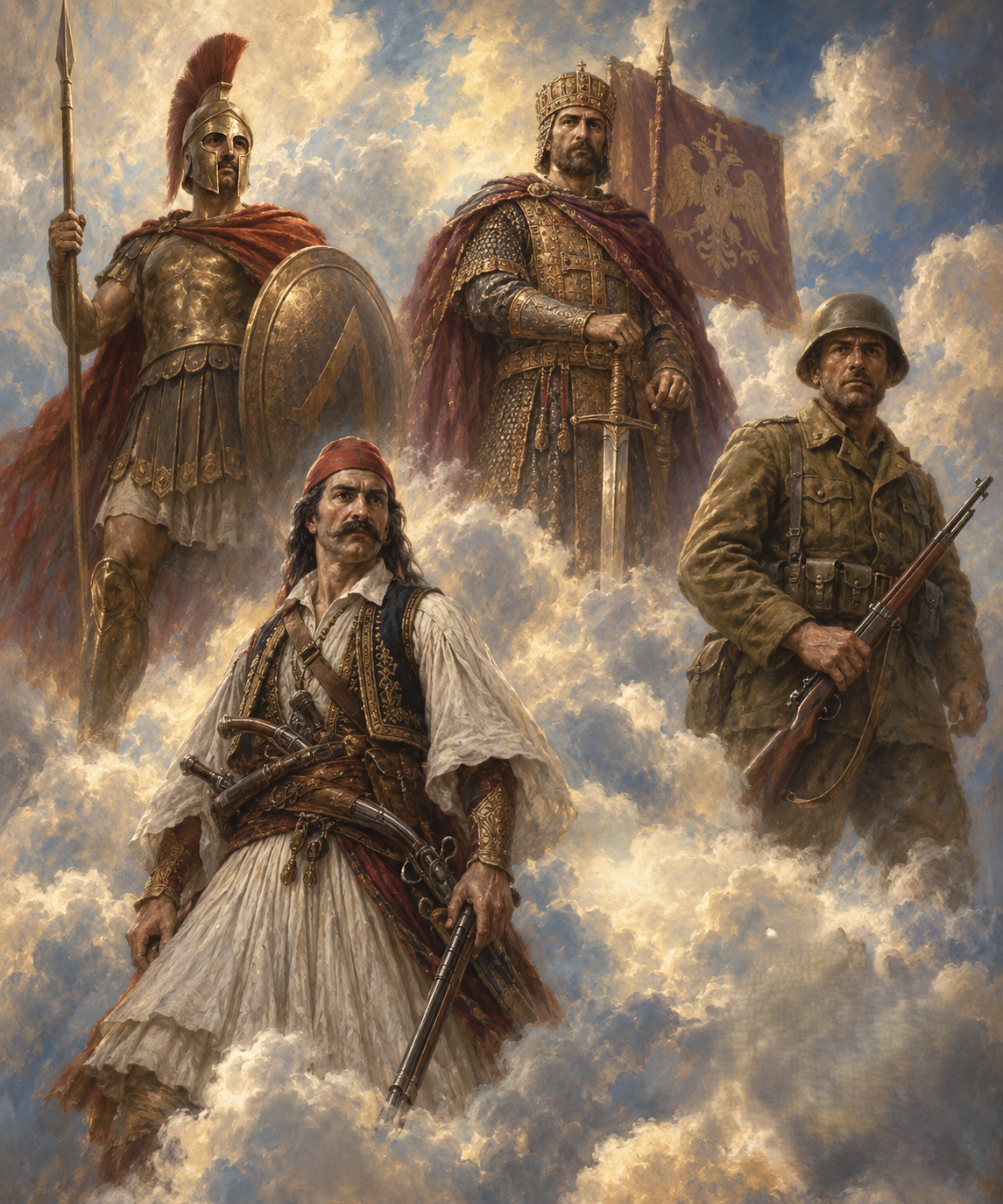
We will not list all the times when the NO was said, but we will remember many and characteristic NOs, which were expressed in different words, but always in similar circumstances. The Greeks, although fewer, have always said NO to more numerous enemies.
And these NOs did not always lead to victory, many times they led to sacrifice. But the NOs always led to glory and freedom. So, let's look at together many of the "no" votes that the Greeks answered, because they always knew, consciously or unconsciously, that: «the blissful is free, but the free is the soulful’ (In other words: happy is the free and free is the brave).
«An excellent wine to defend against the father.»
Hector
As our grandfather Homer tells us in the Iliad, when the Trojans were preparing to attack the ships of the Achaeans, he flew into the sky, to the left of the army, A large and imposing eagle, holding a red, huge, wounded snake in its claws. The snake was beaten and managed to bite the eagle in the chest, near the neck. In pain, the large predator let the snake fall and flew away, croaking away.
As soon as Polydamas, one of the heroes of the Trojans, saw this, he considered it a bad omen. He therefore advised Hector, the most worthy and powerful prince of Troy and leader of the Trojan army, not to fight the Achaeans around their ships, because they would suffer what happened to the eagle. Then the proud Hector looked sideways at Polydamas, rebuked him and said this characteristic phrase: «The best wine of all is to defend your homeland.».
«Molon labe»
Leonidas
Let us be transported to 480 B.C. We are in the straits of Thermopylae. In other words, the Great King, the ruler of Persia, the largest and most powerful empire of that time, has camped with his innumerable and formidable army in front of the straits of Thermopylae. He has a few crazy people in front of him who will not let him pass. He is, however, sure that as soon as they realize how big and strong his army is, they will surrender. Let them not dare, so few who are, to take on him! But to his surprise, not only do they not surrender, but they exercise and take care of their hair in preparation for battle! Well, it can't go any further! He will suggest that they surrender! So, the Persians come envoys to meet the Spartan king Leonidas. And to their surprise, they do not see any gold-adorned, haughty monarch, as they were used to. They see a simple, calm, serious and determined man with a gaze capable of captivating them. And when they asked him to hand over his arms, they hear only two words coming out of his lips, laconically and sternly: «Come and take them»!
«And to give thee the City,
It is not mine, nor of those who dwell in it.
For it is common opinion that we all die of our own free will
and we will not spare our lives.».
Constantine XI Dragasis Palaiologos
And from the king of Sparta in 480 B.C. we come to the Spartan Despot of Mystras and the last emperor of the Eastern Roman Empire (of Byzantium). We are in 1453 A.D., the month of May. Hellenism is now called Romanity, but the essence has not changed. The then all-powerful Sultan of the Ottoman Turks, Mehmed II, has set his sights on the City of cities, the Capital, the once all-powerful Constantinople. He has as his role model the commander Alexander the Great and although he is only 21 years old, his goal and dream is what all the peoples sought at the time: To become the conqueror of Constantinople. He deploys his mighty army, his war machines and his huge cannon in front of the walls of the Capital and sends his envoys to Constantine. He promises him whatever he wants: He will live rich, wherever and however he wishes, as long as he surrenders Constantinople to the Turks. And the last emperor of Rome weighs them within himself. He is completely alone. The West has abandoned him, the Church is hostile to him, the men instead of soldiers become monks, the forces are few, the economy is meager, many rulers are allied with Muhammad. Only a few mercenaries stand by his side. And in the midst of chaos, he decides to bear the fate of his country on his shoulders alone. He will not surrender! He will not betray! Calmly and decisively, he replies to the Sultan: ’To hand over the City to you is something that neither I nor those who live in it can decide. By our common decision we will all die of our own free will and we will not regret our lives.«.
«Freedom or Death»
Theodoros Kolokotronis
The sacrifice of Constantine Palaiologos gave the right many years later to another great man to fight for freedom. Let us move to the revolution of 1821, when the Greeks were fighting to free themselves from the Turks.
William Hamilton, commander of the English warships that patrolled the Aegean Sea to protect the English merchant ships, suggested to Theodoros Kolokotronis that England should mediate with the Sultan, so that a compromise could be made and the war would stop. Let's see what the Old Man of the Morea tells us:
«Once, when we took Nafplio, Hamilton came to see me. He told me that: «The Greeks must seek a compromise and England must mediate.»
I replied that: «This never happens, freedom or death. We, Captain Hamilton, have never made a compromise with the Turk. Some he cut, others he enslaved with the sword, and others, like us, lived free from generation to generation. Our king (Constantine Palaiologos) was killed, no treaty was made. His guard was at war with the Turks forever, and two fortresses were always insubordinate.» He said to me: «What is his royal guard, what are the fortresses?» «Our king's guard is the so-called thieves, the fortresses are Mani and Souli and the mountains.» So he no longer spoke to me.”
«You write me a bougiourdi, you tell me to worship‧
And I, my Pasha, asked who... my own
And he answered me not to worship you‧
And if you come against me, I will fight at once!»
Georgios Karaiskakis
The determination and courage of Kolokotronis' words are also hidden in the words of Karaiskakis, only he expressed them in his own characteristic, foul-mouthed way. The above answer was sent by the nun's son to Mahmoud Pasha Shkodra, who in a message in July 1823 gave Karaiskakis fifteen days to think about whether he wanted to ally with him, otherwise he would fight him.
«Go too, and let your faith, you murtates, perish;
I was born a Greek, I will die a Greek.’
Athanasios Diakos
In this way, our folk poetry preserves the words of the hero of the Greek Revolution of 1821, who was lost so early. In April 1821, Diakos and his brave men put much greater forces of the Turks in the battle of Alamana. The battle was lost, because the Greek chieftains who supported Diakos were forced to retreat and the front collapsed. Diakos fights like a raging lion and instead of saving his last bullet to commit suicide, as he had decided, so that it does not fall into the hands of the Turks, he shoots it to kill another Turk. So he is captured alive and led before Omor Vryonis. Omor Vryonis admires and sympathizes with Diakos, because they had known each other since they lived in the court of Ali Pasha in Epirus. After all, Omor Vryonis himself was a Greek Janissary. Wanting to save Diakos, he suggested that he become a Turk and fight in the Turkish army. The hero did not hesitate to give the above answer, even though he knew that this would be his death sentence.
«Alors, c’est la guerre!» (Well, that means war!)
Ioannis Metaxas
The Prime Minister of Greece, Ioannis Metaxas, and the Italian Ambassador, Manuele Grazi, spoke in French. It was October 28, 1940, 3.00 in the morning. Grazi was at the front door of Metaxas' small house in Kifissia. The doorbell woke up Metaxas, who appeared in a small side door wearing a cotton coat and his not at all luxurious nightgown. He shook Grazi's hand, led him to the living room of the house, and the Italian immediately gave him to read the text that had been assigned to him by the Italian government. In essence, it was an ultimatum by which Italy demanded that it be allowed the free passage of its troops through Greek territory from 6 a.m. on the 28thof the October 1940. Metaxas took the writing in his hands and began to read it calmly and silently. As he read, his eyes watered behind his glasses. He finished. He raised his eyes. He looked the Italian in the eye and gave him the above answer in a steady voice. This answer was embraced by all the Greeks and they simply said: NO! With a no in their hearts, with a smile on their faces and with wishes from mothers and wives, the Greeks ran to the front, to throw the enemies of the homeland into the sea.
«Molon labe»
Grigoris Auxentiou
After the end of the Second World War, Greece regained the Dodecanese in 1947. But how many Greek Haven't lands been liberated? Among them is the martyred island of Aphrodite, Cyprus. On the 1stη In April 1955, the National Organization of Cypriot Fighters (EOKA) began its armed action with the aim of shaking off British colonialism and uniting with Greece.
On March 3, 1957, Grigoris Auxentiou, a 29-year-old EOKA lieutenant, finds himself surrounded by an entire British regiment in his hideout in Machairas. A traitor revealed to the English conquerors the cave where he had taken refuge. An English soldier approaches the mouth of the cave and asks Afxentiou to surrender. At that moment, the same words that were spoken centuries ago by King Leonidas resounded along with a shot from the gun of the Greek hero who threw the Englishman dead. The English were outraged! They began to throw grenades and tear gas and attempted two fierce attacks with barrage of fire from all types of weapons at their disposal. Every time they approached the cave, dead people fell from the young man's weapons. From morning to afternoon the futile siege lasted and a British regiment could not arrest a man. The solution they found was to burn the hero alive. They poured gasoline into the cave and lit a fire. They managed to capture a handful of ashes.
«We do not fight for money, but for virtue»
Kyriakos Matsis
In January 1956, the hero of EOKA, Kyriakos Matsis, was arrested by the British colonizers and subjected to horrible torture for days in order to betray his comrades-in-arms. As he did not succumb, he was visited by the British governor and commander-in-chief of the military forces in Cyprus, John Harding. He promises him his freedom and 500,000 pounds, if he reveals to him where the leader of EOKA, Georgios Grivas Digenis, is hiding. Matsis looks him in the eye, slams his hand on the table and gives the above answer. The British marshal left empty-handed.
And since 1956 let us take a leap to the present. From then until now, have other things been said, no? What is certain is that the cycles of history will once again create the circumstances that will need to be said bravely and resoundingly no. That is why Hermeion teaches its students history and asks them to learn a beautiful verse by heart and make a promise with it. It is a verse that, as Plutarch tells us, children sang at a festival in ancient Sparta, while they danced among their grandfathers and fathers:
«And we are a lot of horses’
(We will certainly become much better)