
My sweet child,
I understand your perplexity. If only you knew, in fact, how many times I have heard it! However, From the outset, it is not properly worded: There are no ancient Greeks!
There is a single Greek language. Philologists may have divided it into various forms in order to make it easier to study (modern Greek, katharevousa, ecclesiastical, vernacular, ancient, etc.), but the Greek language remains one. An excellent teacher I had many years ago, Anna Tziropoulou Efstathiou, taught me that the Greek language is like a woman. This woman sometimes wears a formal dress and beautiful jewelry to go to a reception and sometimes wears overalls to go to the market. But she is always the same woman. And in order to know her, you must know her in all her appearances in all circumstances.
So can the Greek language. All its forms are inextricably linked to each other. And the ancient form of our language is the oldest and the richest; it is the mother who gave birth to her children, that is, the other forms of language. And how can children live without their mothers? Our tongue is a large, green and tufted tree. Ancient Greek is the roots of the tree, while the other forms of the tongue are the branches, the leaves, the flowers. Can a tree live without roots?;
You cannot understand and use the modern Greek language correctly if you do not know ancient Greek. The vocabulary, grammar and syntactic structures of the modern Greek language are imperfect with incomplete rules. Only with knowledge of ancient Greek can modern Greek function properly. Shall I give you examples?;
You say: the sea – of the seas, but the newspaper – of the newspapers. Why don't you say the newspapers? And what is right: the butterfly – of butterflies or of butterflies? Why? And here, what is right? People or people? Why?;
And let's see: You say: The army is parading. Can you say it in one word, that is, it is parading? And what did it do yesterday? Can you say, parade? The volcano is erupting, that is? It is erupting. And yesterday? It erupted! And yesterday? It exploded! Can you find the right forms in your daily life to write and speak correctly? The answers to all the problems you encounter in your everyday speech are found in the ancient Greek language.
Even the meaning of modern words can be understood better and with absolute accuracy, when you know ancient Greek. Let's say, do you know, that the otashields are the shields for your ears, because eota means ears? And when you ask for dessert (on +dessert), do you want to eat something after the main meal? (the doron = meal or dinner). And when you visit the museum, do you know that you are going to a place protected by the Moeses?;
You use all the ancient words and you don't understand it. Other words are the same, such as heaven, helios, which have not changed at all since ancient times, and others are hidden in modern words. For example, you will not say: «I want to drink water», but you will play the plumber. You will not say, «I am going to my house,» but you love your family (that is, the race of people who live in a house). You do not say, «The temple travels to Crete,» but you know the temples. How can you understand what the core is, if you do not know that fire is? The ancient words are not lost, they have not died! They have become mothers, they have given birth to modern words, and they still live hidden within them. You cannot understand modern words if you cannot find their ancient hidden mothers in them.
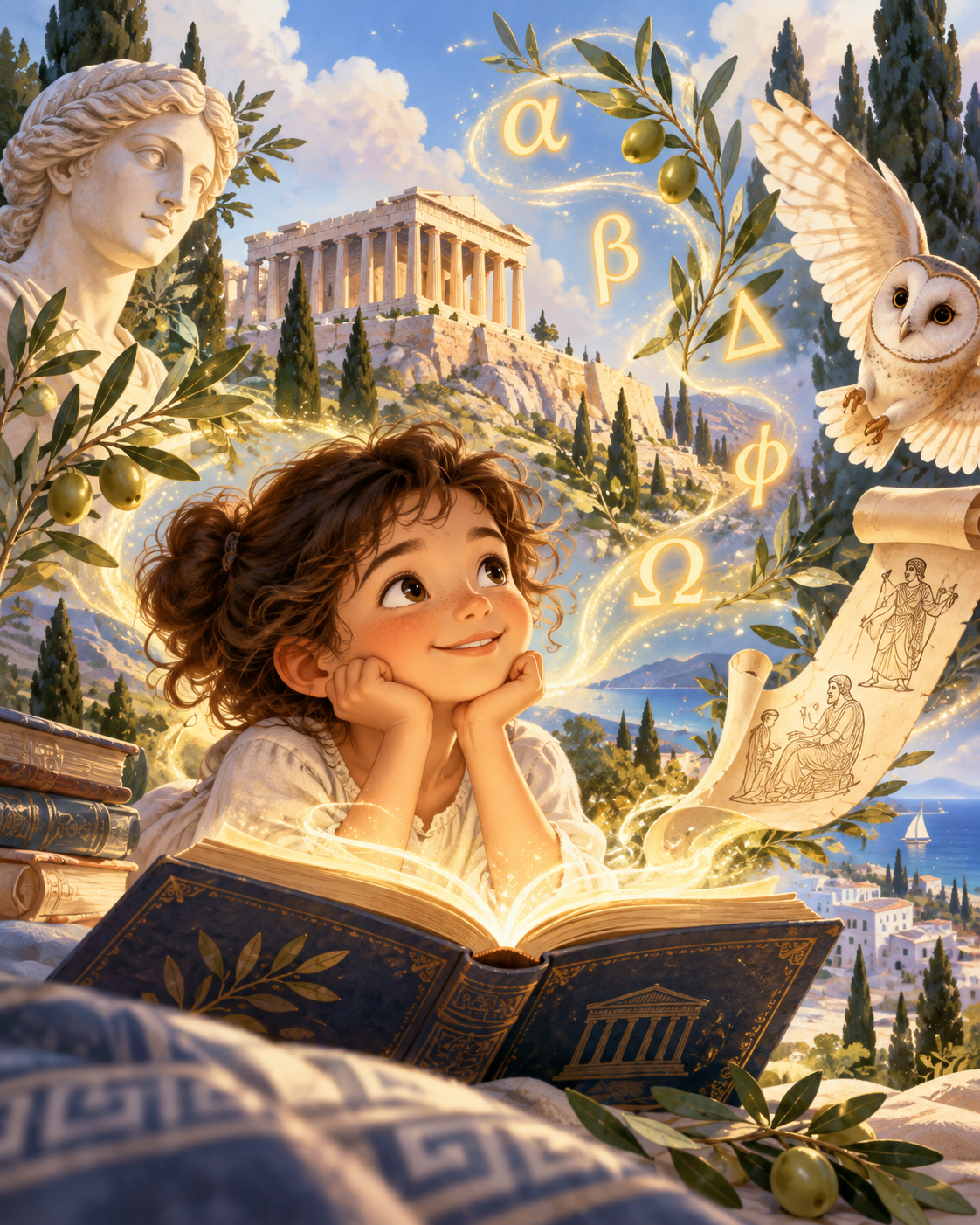 By understanding and using the Greek language correctly (ancient and modern) you are able to understand texts and books written by many important Greek writers. You will not need a translation to understand the beautiful short stories of Al. Papadiamantis or the touching poems of And. Kalvos and the didactic poems of Constantine Cavafy. Even better, you won't need a translation to read the texts of grandfather Homer, grandfather Plato, grandfather Aristotle, grandfather Pythagoras and all your other wise grandfathers.And I suppose that now you will ask me, as they usually ask me? «Why should I read these ancient books?» Because, my dear, they contain so much wisdom and so much counsel that your life will become much easier and much happier. With these books you will become a balanced and intelligent person who will be able to beautify and take care of our world. For example, grandfather Plato will teach you what friendship is, what soul is, what love is... Grandfather Aristotle will teach you how to be happy, how a state should be governed... Grandfather Thucydides will show you the games of power... Even grandfather Aesop will teach you with his myths ways of thinking and behaving. All our grandparents have something to tell you. But because they are no longer alive, so that they can tell you the same things, they wrote their words in books so that they would never perish. Isn't it a shame not to be able to understand the words of your grandparents and to need a translation, which is always lost in meaning and which has usually been written by the English and the Germans? In other words, you need foreigners to tell you what your own grandparents wrote, because you can't understand on your own?!
I have something else very important to tell you! Ancient Greek has such richness and precision of vocabulary and such perfectly elaborated grammatical and syntactic structures, that it can make your little mind very, very clever and agile. There are many studies and researches by foreign and Greek scientists that explain in detail what I am telling you. Here I will give you one or two short examples so that you can understand simply how your cerebral synapses increase by learning ancient Greek:
Think of having the word "do" and being able to transform it with the speed you speak or write and form the formula: we acted together. Or think of meeting the word Safeguarding And you will be able to understand immediately that this is the word Guard. How many thoughts do you have very quickly?;
And one more thing! Today we have the need to place words in a specific order (Subject-Word-Object/Predicate), in order to understand what we are saying. The ancient Greeks put the words in the order needed for their speech to be melodic like a song. Thus the word may have been very far from its subject and object, but they understood very well what they were saying, because their minds were trained.
I hope I don't tire you, my little heart. You can think in peace of mind what I have told you. I will tell you one last thing, so that I can anticipate the next question you will ask me! As if I hear you: «Madam, all this is fine, but isn't ancient Greek very difficult»?;
No, my eyes, they are not difficult! The way they teach them to you at school is difficult! They take you when you are twelve years old, without having told you anything about your grandparents' language before, and they talk to you about heteropersonalities and duplications, as if you were going to take exams to become a philologist. If, however, you start playing with ancient Greek when you are young or small, you will see how easy it is. You are so capable that at a tender age you learn foreign languages. Is it ever possible for your mother tongue to make it difficult for you?;